 Rocket Time
To be decided
BlueBird 14-16 (Block 2 #9-11)
Falcon 9, SpaceX. October to December 2026.
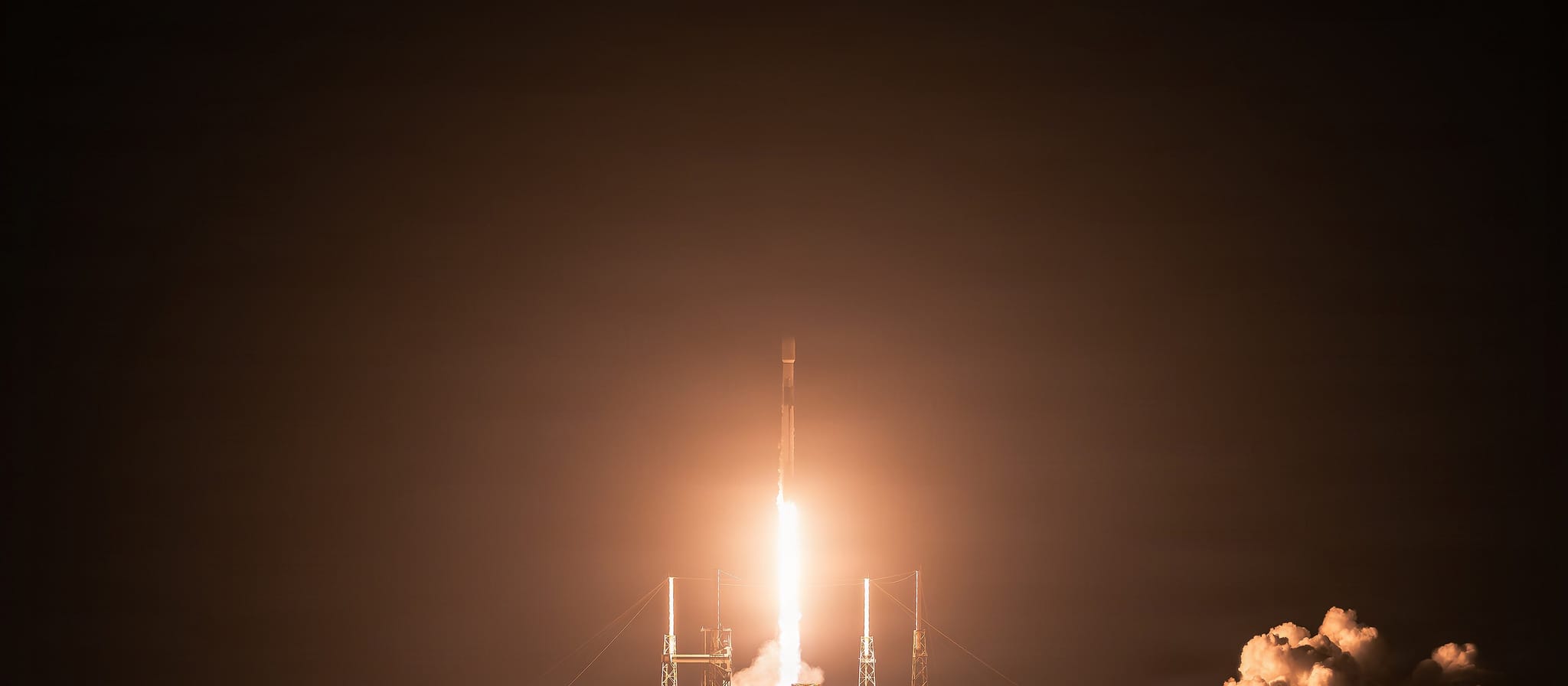
Photo: U.S. Space Force photo by 2nd Lt. Christian Malaniak, Public domain, Wikimedia Commons, cropped

From Columbus
Faint 0.6
Look low in the southeast
In view from 3:54 to 7:34 after liftoff
SpaceX flies a Falcon 9 Block 5 from Cape Canaveral SFS, FL, USA on a communications mission to low Earth orbit. The booster lands on the drone ship A Shortfall of Gravitas.
The mission
AST SpaceMobile’s Block 2 BlueBird satellites are designed to deliver up to 10 times the bandwidth capacity of the BlueBird Block 1 satellites, required to achieve 24/7 continuous cellular broadband service coverage in the United States, with beams designed to support a capacity of up to 40 MHz, enabling peak data transmission speeds up to 120 Mbps, supporting voice, full data and video applications. The Block 2 BlueBirds, featuring as large as 2400 square foot communications arrays, will be the largest satellites ever commercially deployed in Low Earth orbit once launched. This launch will feature 3 satellites.
Facts
- Rocket
- Falcon 9 Block 5
- Provider
- SpaceX
- Launch site
- Cape Canaveral SFS, FL, USA
- Pad
- Space Launch Complex 40
- Orbit
- Low Earth Orbit
- Payload
- Not announced yet
- Booster
- . ASOG autonomous spaceport drone ship
- Height
- 230 ft (70 m)
Timeline
From USSF-627, the last flight like this one.
- T-38:00GO for Prop Load
- T-35:00Stage 1 LOX Load
- T-35:00Prop Load
- T-16:00Stage 2 LOX Load
- T-7:00Engine Chill
- T-1:00Startup
- T-1:00Tank Press
- T-0:45GO for Launch
- T-0:03Ignition
- T+0:00Liftoff
- T+1:07Max-Q
- T+2:26MECO
- T+2:29Stage 2 Separation
- T+2:36SES-1
- T+2:58Fairing Separation
- T+6:06Entry Burn Startup
- T+6:30Entry Burn Shutdown
- T+7:52Stage 1 Landing Burn
- T+8:11Stage 1 Landing